Privacy

EU watchdog tightens privacy rules governing mobile apps

The Article 29, a watchdog comprised of the European Union's top privacy protection groups, today issued a set of new recommendations aimed at app developers and tech giants that run the mobile application stores in the latest attempt to bring order to how your apps handle your private information.

The new set of more detailed recommendations arrives following the recent EU probe into the privacy practices of Google and other tech firms.

The United States Federal Trade Commission set out a similar set of guidelines last month so EU's new recommendations could have serious ramifications on how Apple's App Store, Google's Play Store and other application stores operate...

Apple opposes iPhone tracking class-action bid as ‘desperate’

Apple is once again in U.S. District Court, attempting to derail a lawsuit claiming apps for the iPhone and iPad collected location data and other personal information without explicit permission from users. Responding Thursday to an effort by plaintiffs' attorneys to classify the lawsuit a class action, Apple's legal team argued no harm was suffered and suggested the call for class action status is a "desperate attempt" to collect legal fees...

New document shows extent of the government’s ability to search your iPhone

A new document, submitted to court in connection with a drug investigation, has been discovered that provides a rare look at the amount of data the government can pull from a seized iPhone using advanced forensic tools.

Of course, we all know that phone searches are a common law enforcement tool. But up until now, we've mostly been in the dark regarding what information the government can grab with this invasive search technique...

FTC issues app privacy guidelines, proposes ‘Do Not Track’ for mobile

A patchwork of online privacy measures should be standardized to form a 'Do Not Track' list for mobile app users. In guidelines issued Friday, the U.S. Federal Trade Commission says mobile devices such as Apple's iPhone "facilitate unprecedented amounts of data collection."

Both devices and app developers should obtain users' consent before obtaining personal information such as location, photos or contacts. The set of guidelines accompanied Path's $800,000 settlement with the FTC over grabbing iOS users' personal address books without their consent...

Path pays dearly for stealing your iOS address book data

The private social network Path was off to a great start following its iPhone app launch in November 2010. The success was, unfortunately, short-lived as the company soon found itself at the epicenter of intense public scrutiny after it was discovered it had been uploading iOS users' address book to its servers without their explicit permission. Even though Path did apologize and update the app with the necessary changes and user prompts, the startup never really recovered from the eerie privacy scandal.

And as a result, Apple on its end introduced deeper privacy options in iOS 6 so users can select on a per-app basis which apps can access their contacts, calendars, reminders, photos and more. And now comes word that on Friday The Federal Trade Commission (FTC) announced that Path has agreed to pay a whopping $800,000 fine...

US authorities can access your iCloud data without a warrant

Cloud computing has really taken off in recent years as a cheap, flexible way for folks to store their documents and data. Apple's iCloud service, for example, has garnered more than 250 million users in just a little over a year.

But while we're all busy uploading our lives to the cloud, it's worth mentioning that it's not totally secure from prying eyes. A recently renewed Surveillance Act gives US authorities permission to access your data without a warrant...

Apple drops from top 20 privacy ranking

Are consumers loosing trust that Apple will keep personal information private? That's the implication from new rankings showing the iPhone maker fell out of the top 20 most-trusted firms in 2012.

The firm fell to number 21 after being among the top 20 companies viewed as protecting customer data. Mozilla, the maker of open-source web browser Firefox claimed the number 20 spot, according to privacy watcher Ponemon Institute.

Consumer credit firm American Express again took the number one position in the 2012 privacy rankings. Computer maker Hewlett-Packard and Amazon, creator of the Kindle, ranked number two and three. Amazon improved its ranking, rising to third place in 2012, up from the fifth spot in 2011. Although Apple had ranked as high as number 8 in 2009, confidence in the firm's privacy stance has been shaken over the past year...

New report claims WhatsApp Messenger violates privacy laws

WhatsApp Messenger is a wildly popular cross-platform SMS replacement service. It allows you to group chat and send media files to other users, and it's estimated to have in upwards of 300 million users.

Well if you're one of those 300 million users, you might be interested to know that according to a new report, the app violates international privacy laws due to the way it handles Address Book data...

12 Apple users in UK sue Google over Safari tracking

Although US District Judge Susan Illston recently approved the $22.5 million fine Google agreed to pay in order to settle the FTC claim that it illegally bypassed user privacy settings in Safari, the Internet giant is not yet off the hook over in the United Kingdom, where a group of twelve disgruntled users decided to take the search behemoth to the court over the scandal. A group called "Safari Users Against Google's Secret Tracking" hired a law firm to file a complaint conveniently timed ahead of the sixth annual Data Privacy Day in the country...

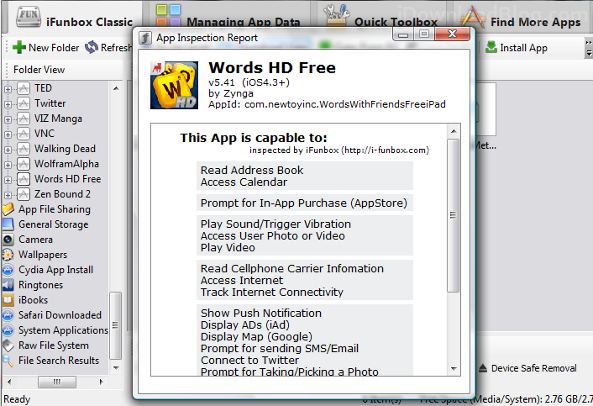
Use iFunBox’s ‘App Inspection’ tool to see which apps can access your data

We've seen services like Clueful catalog apps that can access our private information, and many of us are familiar with tweaks like Protect My Privacy and Firewall iP that attempt to keep our data secure. But what are our leaky apps actually doing, and what are the real risks?

Unfortunately we don't have all the answers for you, but you can do some snooping of your own. The most user-friendly tool for inspecting the APIs your actual installed apps can access is built into a popular iOS filebrowser called iFunBox...

Korean iPhone users drop privacy suit against Apple to pursue $25M case

Back in 2011 a group of 29 people took action against Apple, claiming that the iPhone-maker was illegally enabling location-based features without their consent (you remember locationgate, don't you?). Today, however, they've backed down after failing to provide sufficient evidence.

The group had been seeking 800,000 won (or $757 USD) per person, but will now turn their attention to a separate class-action privacy suit filed with a regional court, which involves claims from roughly 27,000 iPhone owners in the country and could be worth up to $25 million...

The government wants to give you greater control of app privacy and data tracking

We don't often discuss U.S. government action when it comes to iPhone apps. But proposed legislation in Washington has iOS app advertisers up in arms and could even curtail future app development. Known as the "Apps Act", the measure ostensibly is aimed at protecting the privacy of consumers downloading a growing number of apps on mobile devices.

Per voluntary guidelines, Apps Act will require apps to get explicit permission from you before acquiring your name and email address. Among the areas targeted in the US House of Representatives proposal by Georgia Democrat Hank Johnson is requiring app devs to explain how your data will be used and what third parties can access it.

These steps are largely positive and one component of the proposed new regulation is particularly interesting as it would give your the right to delete your personal data used by advertisers...