Display

Qualcomm comes to the rescue, invests $120M in Sharp to help advance IGZO panels

More good news for people keeping their fingers crossed for Sharp's IGZO panels appearing on iOS devices: Tuesday morning, The Wall Street Journal reported that chip maker Qualcomm has agreed to invest as much as ¥9.9 billion, or approximately $120.4 million, in "what is expected to be the first in a series of capital injections to shore up" Sharp's battered finances and advance its IGZO tech.

That's good news as Foxconn's and Apple's multi-billion dollar deals with Sharp appear to be going nowhere. Sharp's stock was downgraded to junk and the ailing Japanese consumer electronics maker is now trying to obtain investments from anyone, be it Apple, Intel, Foxconn or Qualcomm.

The launch of Sharp's awesome, albeit pricey, 32-inch 4K IGZO pro monitor and the introduction of its own tablet, the Aquos Pad SHT 21, which has a seven-inch IGZO display, both indicate yields are improving and so the likelihood of Apple re-considering IGZO panels in future iOS devices is now growing with each passing day...

Apple wins trademarks for the Retina moniker and the Game Center icon design

Apple today received two interesting trademark grants seeking to protect the Game Center icon design and the Apple-coined Retina moniker. The former describes a rounded icon divided into four quadrants, each sporting a distinct combination of colors and shapes. It was originally filed in June 2012 under international classes that cover multiplayer games, scoring and tracking game performance and "providing an online portal for social networking through virtual communities".

More important than the Game Center icon is the widely used Retina name, now a registered trademark of Apple, Inc.

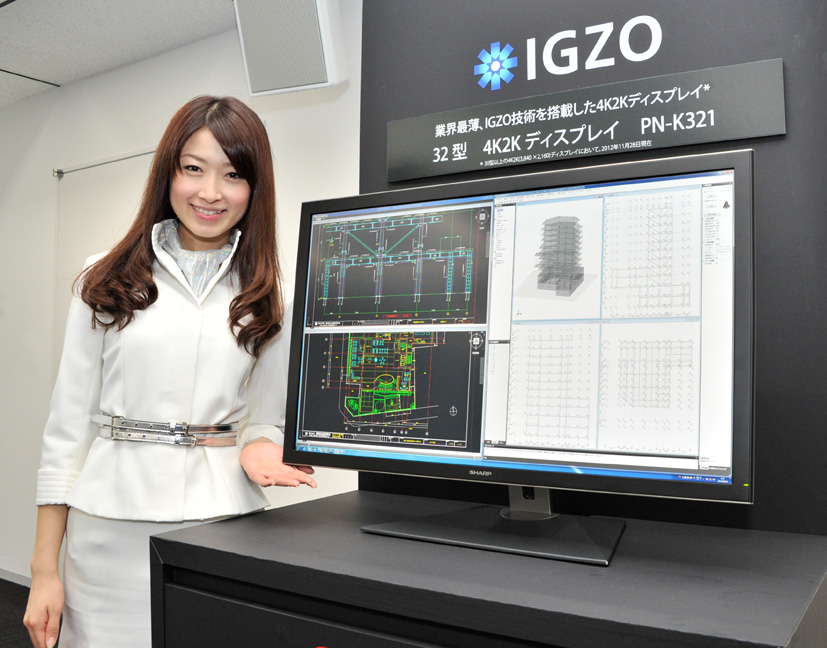
Sharp launches a 32-inch Retina monitor that cries for an Apple HD TV

Sharp, the struggling Japanese consumer electronics maker, is finally taking its low-power IGZO (indium gallium zinc oxide) panels off the ground, announcing Wednesday a 32-inch monitor built around this proprietary display tech. And with 4K resolution of 3,840-by-2,160 pixels, it's a marvel of cutting-edge display engineering.

That's four times the pixels of the current full HD standard which maxes out at 1,920-by-1,080 pixels. In addition to low power consumption, the new monitor achieves the industry's thinnest profile by adopting a specially designed edge LED backlight that's only 35mm deep...

Loss of Samsung screens apparently hurting iPad mini production

Questions of whether Apple can supply enough iPad minis to meet demand continue to linger. After cutting ties with Samsung for its displays, one of the two alternative suppliers reportedly face production problems. All of which makes the executives at Cupertino nervous amid Cyber Monday mania.

Apple reportedly chose LG Display and AU Optronics to replace Samsung. As we reportedly last week, LG Display makes most of the displays for the iPad mini, which is widely viewed as a top pick among Christmas shoppers. However, now comes a report out of Asia that AU Optronics is having problems producing the displays...

The majority of iPad mini screens are made by LG Display, not Samsung

The vast majority of iPad mini units incorporate a 7.9-inch screen manufactured by LG Display, a report out of Asia claims. AU Optronics, another Apple supplier, is said to be responsible for a much smaller portion of orders as it reportedly continues to suffer from poor yields in the production of panels.

The news is another indication of Apple distancing itself from Samsung. Remember, Samsung was originally the primary supplier of Retina screens for the third-generation iPad, until LG Display stole the Apple account in August. The Galaxy maker also lost out on the iPhone 5 front to rival panel makers, although the company still manufactures chips for Apple devices...

Display shootout pits the iPad 3 against the Surface

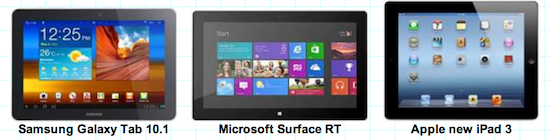
The experts over at DisplayMate have put together another display shootout, this time pitting the Retina screen of the iPad 3 against that of Microsoft's new Surface tablet and Samsung's older Galaxy Tab 10.1. The Galaxy Tab was really just thrown in for good measure here, the real shootout is between the first two.

Last month, a Microsoft engineer claimed that although the Surface has a lower resolution than the iPad, 1366 x 768 vs 2048 x 1536, its display can still outperform it. DisplayMate's Raymond Soneira laughed off the claim, saying there was no way this was possible. And now he has the head-to-head tests to prove it...

Does the iPhone 5 have a touchscreen bug?

http://www.youtube.com/watch?v=BnioM-nkhqc

Both Apple's iPhone 5 and the latest fifth-generation iPod touch exhibit an unusual problem affecting how the devices handle touch input events. As noted by game developer CMA Megacorp, if you slide your finger back and forth across the display rapidly, input events drop out or stop altogether. Worse, the issue also affects scrolling and swipes and is exacerbated by scrolling diagonally. While many people never use rapid swiping motions to operate their device, games like Fruit Ninja rely on moving one's finger across the touchscreen in a rapid succession...

Rumor: the next iPad mini will have Retina display

Moving to blunt criticism over the iPad mini display, a rumor out of China asserts that AU Optronics (AUO) is working on building a crisper Retina screen for the next iPad mini with the same 326ppi pixel density as the iPhone 4/4S/5. AUO is one of the suppliers Apple sources display panels for the iPad mini from. The need to offer a Retina iPad mini was allegedly pressing enough to bypass the usual waiting period before providing sharper display...

Did Apple bail out Sharp to the tune of $2 billion?

A detective story of sorts is unfolding in Silicon Valley. Did Apple spend $2 billion to prevent Japan's Sharp going under and putting the iPhone 5 in jeopardy? That's the belief of one analyst who did what all good investigators do: follow the money. Sharp was in financial trouble. It lost $1.3 billion in early 2012, was facing another $2.3 billion due in 2013 and lost a potential lifeline from Foxconn.

In late August came word that Sharp's production of touchscreens for the then unreleased iPhone 5 had slowed. A delay could crimp the Cupertino, California company's ability to meet the expected high demand for its new product. But just weeks after that dire warning, news broke in September that Sharp was producing "mass quantities" of the displays. What caused the sudden turn-around? Apple, some say...

Verizon and HTC announce November 13 media event

Apple continues to struggle to keep up with iPhone 5 demand, and Samsung just announced that it's sold more than 30 million units of its flagship handset, the Galaxy S III. Is there room for another big player?

HTC is hoping so, as the Taiwanese company has just sent out press invitations for a jointed Verizon media event to take place on November 13th. And word has it that it's going to unveil a new 5-inch superphone...

Apple rumored to be investing in Sharp

Sharp, who makes TVs, displays and other electronics, is in serious trouble right now. The company is bleeding money, its stock price is plummeting and it says that it's not sure that it can continue to operate.

In fact, the dyer situation has Foxconn worried enough that it's thinking about pulling out of its deal to buy an 11% stake in the company. But according to a new report, Apple may be looking to help out...

Low touch screen yields blamed for the iPad mini’s price tag

With so many people seemingly disappointed that the iPad mini starts at $329 rather than $249 or even $199, we polled you ahead of the announcement on the price and only seven percent thought only Apple could get away with pricing the device at $329. And yesterday, in another poll more than forty percent said they would be getting one (more than half would opt for the entry-level WiFi-only model).

No question some people will go for a Nexus 7 or Amazon's Kindle Fire because not everyone can afford a $300+ tablet. But why exactly Apple didn't make a sub-$300 iPad? According to supply chain sources, low yields for touch screens are to blame...