Apple has launched a new device called the “HomeView,” which is a smart home hub with a 7-inch square touchscreen display, FaceTime camera, speakers, and microphones.

It’s a fusion of a HomePod (on the speaker side) and an iPad (on the display side), meant to sit on a desk or tabletop, or be mounted to the wall.
You can use it to ask Siri all sorts of questions, control your Home, view CCTV camera feeds, make FaceTime calls, listen to music, see recipes on the screen, access your messages or have it read to you, reply to messages using voice or on-screen keyboard, use it as an Intercom machine to broadcast to other devices in your house, and more.

Just as HomePod can recognize different family members by voice, the new HomeView can recognize up to 6 users by face (using the front camera; HomeView doesn’t have Face ID). Based on this recognition, it can show personalized responses for that person in Siri, Messages, Calendar, Reminders, FaceTime, and Find My.

Here’s a quick summary of what you need to know about it.
Types

HomeView comes in two flavors:
- One has a speaker base that’s meant to sit on your desk or tabletop.
- The other is wall-mounted, which you can DIY-install or have a professional install it on your wall.
Fine print on Apple’s website says this about the wall-mounted version:
“HomeView (Wall Mounted) will be available with a choice of three purpose-built mounts from Schneider Home. Power Mount USB‑C Wall Connector, available starting at $59.95 (U.S.), and Power Mount AC Wired, available starting at $79.95 (U.S.), can be ordered starting today from apple.com/store and in the Apple Store app. Power Mount PoE Wired will be available starting in early 2027 for $129.95 (U.S.).”
I’m sure that within a few weeks of launch, you’ll be able to find third-party mounts on Amazon for far less.
Colors

Apple HomeView comes in 4 colors: silver, starlight, rose pink, and space gray.
The wall-mounted version comes in just 2 colors: space gray and silver.
Price
Both the normal and wall-mounted versions cost $299 in the United States, $429 in Canada, A$449 in Australia, £299 in the United Kingdom, and ₹39900 in India.
The wall mount will cost more overall because you’ll need to buy the mounts, cable, and adapter separately (more in the next section).
What you get in the HomeView box

Apple’s pre-order page says the tabletop version comes with a color-matched USB-C cable and a 30-watt adapter.
However, the wall-mounted version doesn’t include any of these, even though it costs the same. You’ll have to buy mounts and adapters separately.
Construction

HomeView is made of aluminum, and the display connects to the domed speaker base with a stainless steel hinge. The hinge allows smooth tilting, so you can view it comfortably whether sitting or standing.
Weight
The desk version weighs 2.1 pounds (952 grams). The wall-mounted version weighs just 0.63 pounds (286 grams) because it lacks the large bottom speaker setup.
Dimensions

See the image above for its size.
- Left to right: 5.73 inches (14.55 cm)
- Top to bottom: 5.38–6.82 inches (13.67–17.32 cm)
Display

Apple HomeView has a 7-inch diagonal Liquid Retina IPS technology multi-touch display with 1088-by-1088-pixel resolution at 220 ppi. The display supports True Tone, has a fingerprint-resistant oleophobic coating, and reaches up to 500 nits of maximum brightness (the same as a MacBook Air display) and 0.3 nits of minimum brightness so that it isn’t too bright when you use it as a desk clock in your bedroom at night.
Smart software
Apple says that:
“The HomeView interface intelligently adjusts based on the user’s distance, showing simpler information that’s viewable from across the room and richer detail as they step closer.”
Faces

Like Apple Watch and iPad widgets, you can customize the HomeView screen with faces that show the time, calendar, photos, weather, and more.
Camera

This smart home hub device has a 12MP Center Stage camera at the top for FaceTime calls. The camera has an ƒ/2.4 aperture.
Speakers

The desk version of HomeView has:
- Two custom full-range drivers
- Custom down-firing woofer
- Dual force-canceling passive radiators
The wall-mounted version has only two custom full-range drivers, with no woofers or passive radiators. But Apple tuned it specifically for on-wall placement, so it still sounds decent with less hardware (this is what Apple claims).
Microphone

Apple HomeView has four microphones for far-field Siri, so it can hear you better when you a question or are on a FaceTime call. Here are their placements:
- Front microphone (near the camera)
- Rear microphone (on the backside at the top)
- Left and Right microphones (on the sides)
These microphones also support the Sound Recognition feature, so the device can listen for smoke and carbon monoxide alarm sounds and alert you.
Sensors
HomeView has an ambient light sensor (the same one found on phones, tablets, and laptops), so it can automatically adjust screen brightness based on the surrounding light.
It also has a temperature and humidity sensor, so you can get data for the room your HomeView is in.
Finally, it has an accelerometer for some neat features that aren’t publicly known yet.
Chip
HomeView is powered by an Apple A18 chip, which is the same chip found in iPhone 16, 16 Plus, and 16e.
Wireless tech
Apple says the HomeView hub supports Wi-Fi 6E (802.11ax) with MIMO9, simultaneous dual-band, peer-to-peer discovery for easy guest access, Thread networking technology, and Bluetooth 6.0.
Handoff
Like HomePod, you can bring your iPhone near your HomeView, and it will hand off music or podcasts from your mobile to this home hub. Apple says:
“With Handoff, users can continue listening to a song they were playing in the car or on a walk by placing their iPhone in front of the HomeView display.”
Multi-setup
Apple further says that:
“By setting up multiple HomeView, HomePod, HomePod mini, and AirPlay-compatible speakers around the house, users can enjoy music throughout the entire home with multiroom audio.”
Power Requirements
While the tabletop version of HomeView comes with an Apple 30-watt adapter, the wall-mounted version requires you to buy a minimum 20-watt power adapter separately.
What you need to set up HomeView
You must have an iPhone or iPad running the latest version of iOS 27 or iPadOS 27 to set up your new HomeView.
Apps
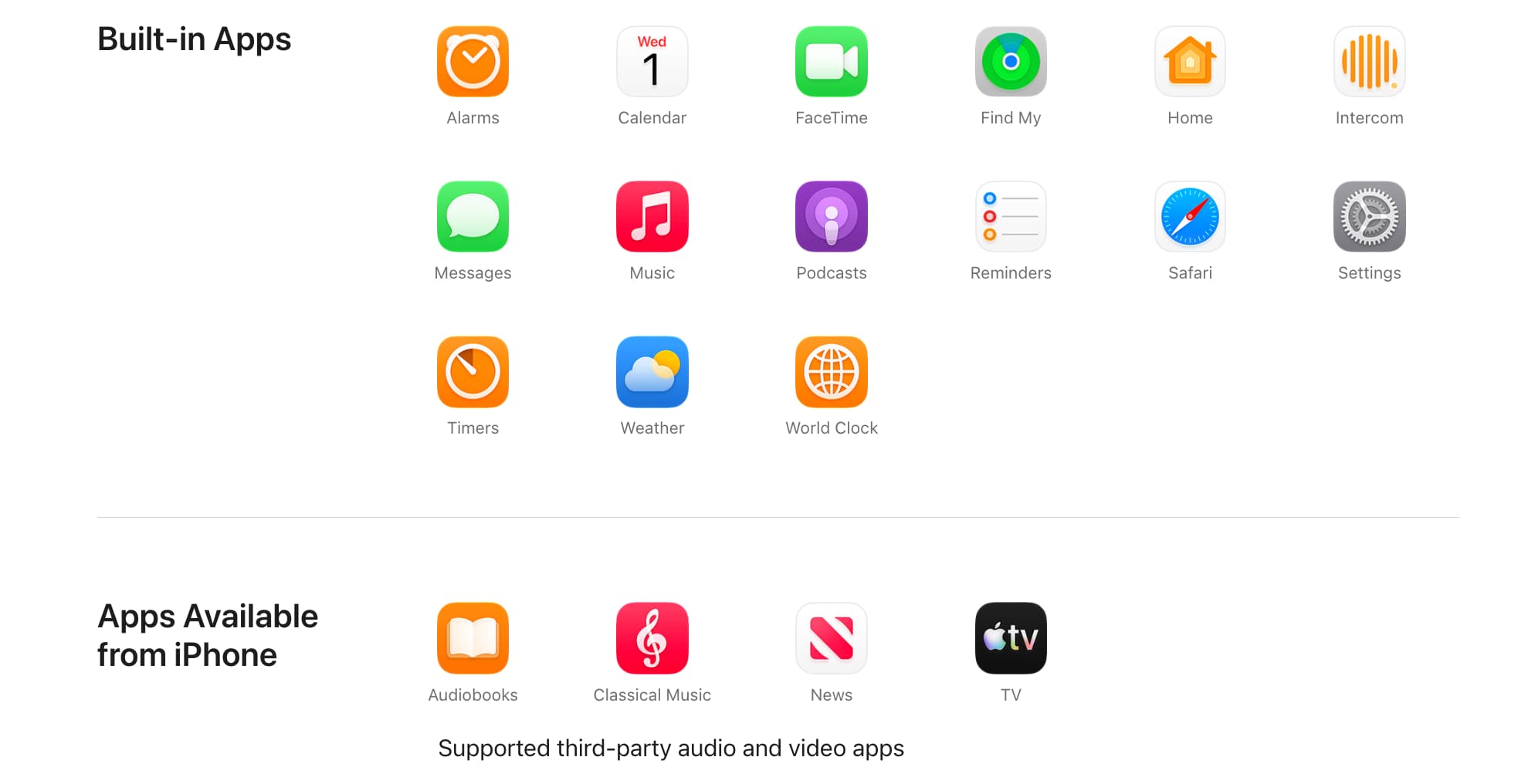
Out of the box, Apple says that the HomeView comes with the following built-in apps:
- Alarms
- Timers
- World Clock
- Calendar
- FaceTime
- Find My
- Home
- Intercom
- Messages
- Apple Music
- Apple Podcasts
- Reminders
- Safari
- Settings
- Weather
Additionally, Apple mentions that Audiobooks, Apple Music Classical, News, and Apple TV apps will be available from users’ iPhones.
On top of that, the new HomeView will also support third-party audio and video apps.
Spotify, YouTube, Netflix, etc., may support it soon. But don’t take my word for it; Spotify and Netflix still don’t have apps for Vision Pro, and YouTube was reluctant to support visionOS at first.
Siri languages

Siri AI on HomeView is available in English only in the U.S., the UK, Australia, Canada, New Zealand, Singapore, South Africa, and India.
Accessibility
Apple says the new HomeView supports the following accessibility features:
- VoiceOver
- Screen Zoom
- Voice Control
- Switch Control
- AssistiveTouch
- Real-Time Text
- Live Speech
- Live Captions
- Siri and Dictation
- Type to Siri
- Vocal Shortcuts
- Subtitles and Closed Captioning
Pre-order and availability
- Australia, Canada, India, New Zealand, the UK, and the United States: You can pre-order it today (October 13) on Apple’s website.
- Singapore: October 15, at 9 a.m. SGT
- South Africa: Pre-orders can be placed through Apple Authorized Resellers.
HomeView will be available to customers in all the above countries beginning November 13 (Friday).
What about the EU?
At its core, HomeView is a Siri AI-powered device. Because Siri AI isn’t available in the European Union, this new smart hub won’t be available for sale there either. Apple says it is “working constructively with the EU in an attempt to find a path forward.”
What do you think of this new smart home device? Will you be buying one?
All images in this post are from Apple.