Go through this quick checklist that will help you secure your WhatsApp account and protect it from hackers and unauthorized access.

WhatsApp is the world’s most popular instant messaging service, and scammers, hackers, and other nefarious actors constantly try to get into other people’s accounts to steal personal chats, receive codes from businesses, impersonate and trick family members & friends into sending money, and so on.
The following solutions should help protect your WhatsApp account.
Lock the app or individual chats
If you’re concerned that people around you, such as your family members or work colleagues, might be looking at your private chats, simply lock the entire app using the built-in iOS app locker feature.

In case you want to lock and hide a specific chat, WhatsApp offers that option as well, which we have explained in our dedicated tutorial: Lock your WhatsApp chats on iPhone like a pro
Turn on two-factor authentication
When you or someone with access to your phone tries to sign in to WhatsApp on a new device, a one-time code is sent via SMS or phone call to the registered phone number. You can add an additional layer of protection by enabling two-factor authentication. This will ensure that even if someone has your phone or SIM card, they will need to enter your 2FA code (which only you know) to finish registration on a new device.

When setting up two-factor authentication, don’t forget to add and verify your email address so you can use it to recover your account when needed.
If you ever get a code (via SMS or call) on your phone to register WhatsApp on another device and you’re not the one doing it, then under no circumstances should you share that code over a call or text. Remember that WhatsApp Support will never ask you for login codes. Anyone doing so is certainly a scammer trying to take over your account.
Periodically review the devices where you are logged in
Go to WhatsApp Settings > Linked devices and review the list of phones, tablets, computers, and web browsers where you’re logged in to this WhatsApp account. If you no longer use a linked device, tap it, followed by Log Out.

Enable additional encryption for your chat backups
If you back up your WhatsApp chats to iCloud, you can add an extra layer of security and privacy by enabling end-to-end encryption in WhatsApp Settings > Chats > Chat backup.
Don’t reply to random messages or pick up unknown video calls
If you get random texts or calls from unknown numbers, don’t reply or pick up, even to ask who they are. Just ignore it or check their number on sites like Truecaller, then decide on an action. If they feel like a scammer, they probably are; block and report that account.
Unless mandatory, don’t go around sharing your phone number with random websites, shops, people, etc. This will cut down on both promotional spam texts and also enhance your security.
Don’t tap on random links
Being an iPhone user, you don’t have to worry about a scammer tricking you into installing a spyware app on your phone by sending you an APK file (these only work on Android phones). But you can still be victims of phishing scams via links and media attachments. So, if you get a suspicious link, photo, video, or PDF, don’t tap it. Just delete and report the message.
Update the app regularly
Another basic thing you can do is to update the app regularly. In case there is a bug or open exploit in the current version of the app, WhatsApp will proactively implement a fix via an app update.
Add a PIN to your physical SIM and secure your identity in general
eSIMs are already protected by the iPhone passcode, but if you use a physical SIM, secure it with a 4-digit PIN. Moving forward, PIN will be required to use this SIM even on other phones (iPhone, Android, feature phones).
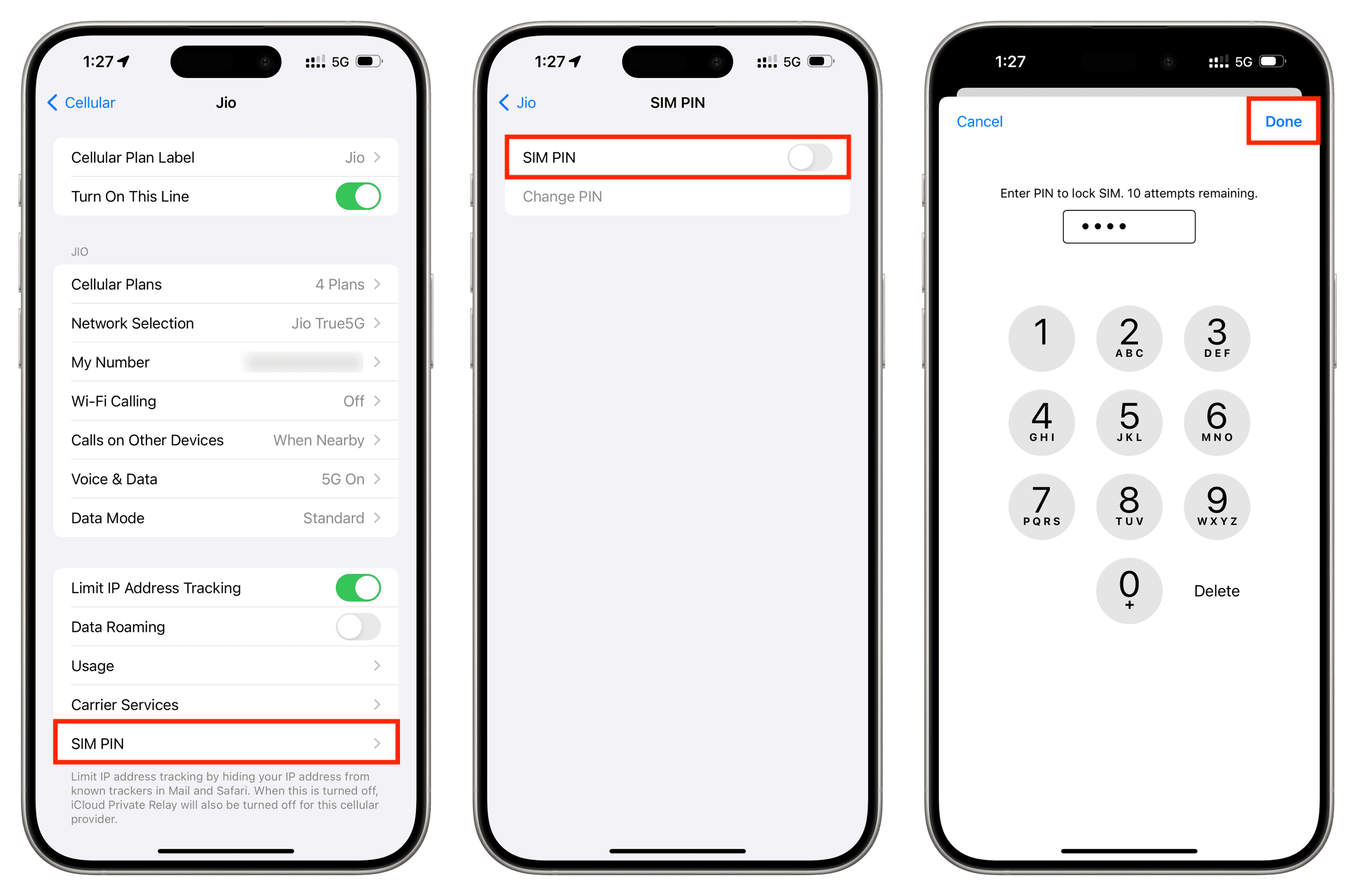
You can also consider setting up passkey for your WhatsApp account that uses Face ID or Touch ID to authenticate. It’s available in app Settings > Account > Passkeys.
Secure your iPhone
And finally, WhatsApp is just one of the apps on your smartphone. If you don’t take steps to secure your iPhone, it can lead to all sorts of issues, including your WhatsApp account being compromised.
On a related note: 5 optional iPhone features to strengthen privacy and security