Learn how to connect a wired or wireless mouse to your iPhone, customize the mouse buttons, and use it alongside touch input.
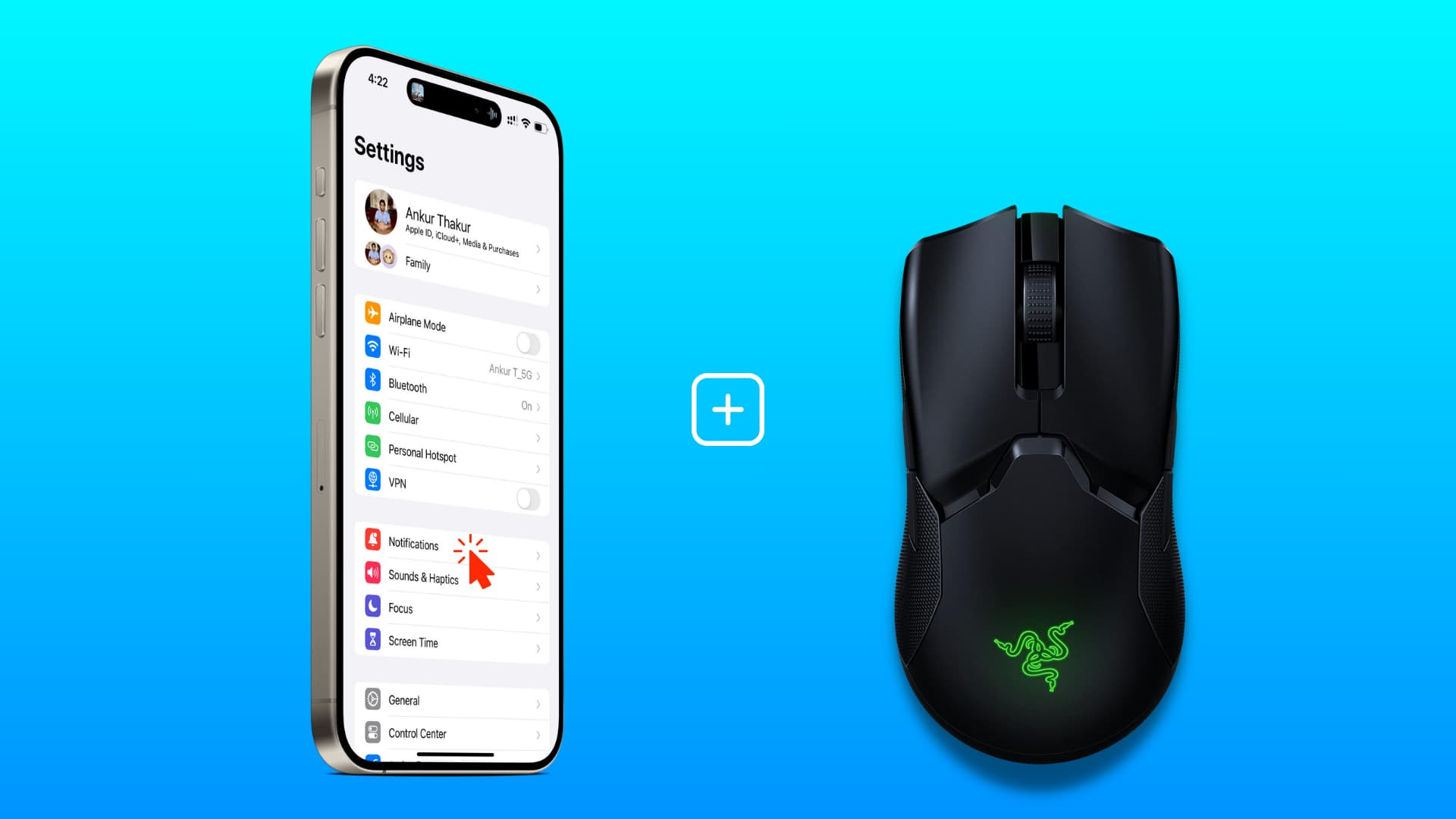
While iPadOS has clear mouse support, iOS doesn’t. In fact, Apple even restricts its own Magic Mouse from appearing in the Bluetooth section of the iPhone Settings app.
That said, Apple doesn’t block you from using a third-party mouse with your iPhone, but it needs a couple of extra steps, which we’ll explain for you.
You may want to use a mouse on your iPhone if you’re unable to interact with the touchscreen due to a physical disability or if you need fine-tuned scrubbing and precise controls while editing a video in iMovie or other apps.
What kind of mouse can you use with an iPhone?
You can use pretty much any wired or wireless Bluetooth mouse with your iPhone. However, you can’t use Apple’s own Magic Mouse, and it won’t appear as a pairing device under iOS Bluetooth settings.
Connecting a wired mouse to iPhone
Connecting a USB-C mouse with the iPhone 15 and later is a no-brainer, as you can just plug it into the phone’s USB-C port. However, if your mouse has a regular USB-A connector, you’ll need a suitable USB-C to USB Adapter (for iPhone 15 and newer) or a Lightning to USB adapter (for iPhone 14 and older).
Here’s how my setup looks using a USB-C dongle; of course, things are cleaner with a Bluetooth mouse.

How to use a wired or wireless mouse with iPhone
It involves three easy steps.
Step 1: Connect the mouse to your iPhone
Plug in the wired mouse to your phone.
To pair a wireless mouse:
- Put the mouse into pairing mode by powering it on or holding its pairing button, typically located on the underside.
- Go to iPhone Settings > Bluetooth, tap your mouse under the “Other Devices” heading, and confirm by tapping “Pair.”

Important: Some mice are designed to work with only one device (such as a computer, tablet, or phone) at a time. If you don’t see it in iPhone Bluetooth Settings, forget the mouse from its previously connected device, or reset it.
Step 2: Turn on AssistiveTouch
It’s mandatory to enable AssistiveTouch on the iPhone before you can use a connected or paired mouse.
- Open the iOS Settings app and go to Accessibility > Touch > AssistiveTouch.
- Turn on AssistiveTouch, and now you should see the small round mouse pointer on the screen (alongside the regular AssistiveTouch virtual button).

Your mouse is now ready for use on your iPhone. In most cases, the left mouse button should do a single click/tap. And if your mouse has a scroll wheel, it should work as well. However, if they don’t work, see Step 3 below.
Step 3: Map the mouse buttons to correct actions
Whether the physical mouse buttons don’t work on your iPhone or you want to personalize your experience, you can do that by mapping system features, Accessibility options, scroll gestures, Dwell Controls, Siri shortcuts, and more. So, if your mouse has extra buttons, you can map them to take you to the iOS Home Screen, open the camera, run a shortcut, etc.
1) Go to iPhone Settings > Accessibility > Touch > AssistiveTouch.
2) Tap Devices under the Pointer Devices heading and tap your connected mouse.

3) Tap Customize Additional Buttons. It will show a pop-up saying, “Customize Button; press a button on your pointer device to choose an action.” Do not tap Cancel.

Just press one of the physical mouse buttons on the connected mouse, and now your iPhone will display a long list of actions you can map this mouse button to do.

I’ve set the left mouse button to do a Single-Tap (one finger tap) and the right mouse button to do a Long Press (touch & hold). If you have a mouse like the Logitech MX Master with more than two buttons, you can repeat steps 3 and 4 and configure all mouse keys to different actions. To remove a mapped key, swipe left on it and tap Delete.

You can also tweak other options from the AssistiveTouch settings screen.
Using a mouse in iOS
For the most part, you can use the mouse normally, just as you would on a computer, and the mouse buttons can mimic the gestures you make with your fingers.
However, if you need help, here’s how to perform some essential actions throughout iOS using your mouse. Just remember that my left mouse button is set to Single-Tap, and the right mouse button is set to do a Long Press. Plus, my mouse also has a scroll wheel.
- Go to the Home Screen: Take the pointer to the very bottom of the iPhone screen, press & hold the mouse’s left button, and drag up to go Home.
- Enter App Switcher: Follow the above steps and hold instead of swiping all the way to go Home.
- Open Notification Center and Control Center: Take the mouse pointer to the top-center or top-right of the iPhone screen, press & hold the left mouse key, and drag it down.
- Touch & hold: Press & hold the left mouse key or just press the right mouse key if, like me, you’ve also configured it to do a long press.
- Swipe to another Home Screen page: Put the mouse pointer on the dots above the dock, press & hold the left mouse key, and drag left or right.
- Open Spotlight: If your mouse has a scroll wheel, swiping it on the Home Screen should open the iOS Spotlight Search. If not, press & hold the left mouse key on the Home Screen and swipe down.
Here’s a quick video I recorded on my desk that shows me using a regular five-dollar wired mouse with my iPhone:
The iPhone touchscreen may feel a bit abnormal
When you’ve paired a mouse with your iPhone, the touchscreen may require you to perform a longer swipe with your finger to do things like switching between Home Screen pages. It can feel out of place.
To fix this, disconnect your mouse by turning off the iPhone’s Bluetooth or disconnecting it from the iOS Bluetooth settings. Then, restart your iPhone, and its touchscreen will be back to normal.
Also, check out: