Apple

iPhone 8’s Touch ID said to use on-screen optical fingerprint scanning

Apple is said to have developed a next-generation Touch ID sensor where an OLED display of the device doubles as a fingerprint sensor. This should enable users to rest their finger on the display to authenticate themselves.

According to a Chinese-language Economic Daily News report, citing sources from Apple's chip supplier Taiwan Semiconductor Manufacturing Company, Apple has managed to develop an optical fingerprint sensor to enable authentication directly on the screen.

KGI Securities analyst Ming-Chi Kuo first called it in January.

He said because Touch ID’s capacitive sensor does not work through the display’s cover glass, Apple could go with an optical sensor which doesn’t require physical contact with a user’s finger.

Other iPhone 8 features, according to a TSMC source, include no physical Home button, the screen ratio of 18.5:9 instead of the previous 16:9 and invisible infrared image sensors to enhance camera functionality and enable augmented reality features.

Apple is understood to have been plagued with yield issues regarding the new optical fingerprint sensor. It's unclear if the company has managed to resolve those technical issues.

Apple to live stream WWDC 2017 keynote

Apple is going to once again be providing a live stream of its WWDC keynote address this year. On Thursday the company updated its website with a new page noting that a stream of the keynote will go live on June 5th at 10am PDT.

You will be able to tune in on your Mac and iOS devices, using the Safari browser, and of course on Apple TV. Second and third gen models of the set-top box will feature an Events channel, and fourth-gen models will get a standalone app.

Apple is expected to use the keynote to introduce the next major versions of its four platforms: iOS, macOS, watchOS and tvOS. There's also been rumors speculating that the company will debut new Mac and iPad hardware during the event.

Even if you plan on watching the keynote, be sure to join us here at iDB that Monday. As usual we'll be covering the event live, as well as all subsequent announcements and releases, so you'll be able to keep up with the news throughout the day.

Source: Apple

Watch new Earth Day video Apple shared at Sustainable Brands conference

Apple celebrated Earth Day 2017 by announcing a partnership with World Wildlife Fund, promoting environmentally-focused apps on App Store and posting cartoonish videos on YouTube detailing its efforts to preserve our environment for generations to come.

Today, more than a month after Earth Day took place, it shared another Earth Day video on YouTube, titled “Does my iPhone believe in incarnation?” and featuring its recycling robot Liam.

The clip was created to celebrate Apple's attendance at Sustainable Brands 2017, a Detroit conference where Sarah Chandler, Apple's Director of Operations and Environmental Initiatives, discussed Apple's plan to reduce the environmental impact of its supply chain.

https://www.youtube.com/watch?v=aDXy5bEG38w “Lisa Jackson, Apple’s lead on Environment work, and our recycling robot Liam will make you believe,” reads the video's description. “Lisa and her team explain it all, while Liam disassembles your iPhone 6 so those parts can find new life.”

Bt taking apart used products, Apple is able to recycle rare earth materials and other valuable metals and send them back to its supply chain for further processing to be eventually reused in the production of components for new products.

According to the video, L.I.A.M. stands for “Liberate. iPhone. Auto-Disassembly. Machine”

Question: why does the video briefly show Tim Cook holding a bunny?

Facebook is making Instant Articles compatible with Apple News and Google AMP formats

Facebook is rolling out new tools today to help publishers who post Instant Articles on the Facebook platform make their fast-loading news stories compatible with the Apple News format and Google's Accelerated Mobile Pages.

According to the social networking giant, an updated Instant Articles SDK, now available on GitHub, allows publishers to build content publishable as Google's Accelerated Mobile Pages.

Support for Apple News articles is coming soon, says Facebook.

Politico reported today that Apple has created a new Editor-in-Chief position on Apple News. The Cupertino giant hired Lauren Kern, former Executive Editor at New York Magazine, for the newly created position.

Facebook's updated SDK removes a time and resource-consuming step in publishing on multiple platforms by having the markup publishers use to create Instant Articles automatically generate the code needed to build these other formats.

For instance, any custom formats—things like fonts, colors and captions—that publishers have designed in the Style Editor will now be “closely mirrored” in the other formats.

The company wrote:

Media executives told us about the challenge they face using multiple platforms to share their stories–more distribution formats create more content management costs.

Developers who attended our Journalism Project Hackathons in New York and London also asked for a way Instant Articles could support other major publishing formats.

Instant Articles debuted as an iPhone exclusive in May 2015.

Rival Google launched Accelerated Mobile Pages in October the same year. Both features aim to make news articles from participating publishers load in a fraction of a second on mobile devices than their non-optimized versions.

Both Google and Facebook want to speed up webpage loading times, especially for users in emerging markets and those on unreliable or slow Internet connections. The faster the page loads, the more likely the user is to actually read the article. And the more news articles users consume on any given day, the more ads they'll see.

Instant Articles have been criticized for being confined to Facebook's wall garden and their ad system. As for Accelerated Mobile Pages, Google is giving them preferential treatment in search results, but the implementation leaves a lot to be desired.

While these pages do load significantly faster versus the regular mobile pages, all Accelerated Mobile Pages implement Google's own scrolling behavior that feels weird on iOS while making it harder than necessary to visit the original article.

Accelerated pages have their own unique URLs. To visit the original article, you must first tap the hyperlink icon at the top of the page to reveal the original URL, then tap the URL to visit the original page on the publisher's website.

The worst thing about Google's accelerated pages is the fat that they don't let you use Safari's clutter-free Reader Mode or the Find in Page feature, available from the Share menu.

New Pokémon game is based on Magikarp, the weakest Pokémon ever

If you're no longer interested in playing Pokémon GO on a regular basis, how about another mobile Pokémon game? Your wish is Pokémon Company's command! Today, they released a new Pokémon game on App Store, based on the weakest Pokémon ever— Magikarp.

Titled Pokémon Magikarp Jump and available on App Store as a freemium download with optional In-App Purchases, the game requires you to raise multiple generations of Magikarp.

You must feed and train your creatures, boosting their stats and Jump Power before challenging other players in six leagues to increase your own Trainer Rank. Those who do well in jumping tournaments can get commemorative photos of their achievement that can be shared on social media to show the world how well they’ve trained their Magikarp.

If you're new to the Pokémon phenomenon, here's a little backgrounder on Magikarp.

Magikarp is a creature famous for being pathetically weak, unreliable and generally useless. It cannot be taught any powerful moves—all it does is flop around and splash. If your Magikarp flops too high, it is sometimes snagged by the bird Pokémon Pidgeotto.

Check out the launch trailer below.

https://www.youtube.com/watch?v=cZ0c9s5UoMI

If Magikarp gets knocked out during a training session, or retires upon reaching level 20, you’ll start over with a new generation of Magikarp that's a little bit stronger than your last.

Some Pokémon you encounter may give you food to keep your Magikarp nourished.

Following the initial launch in Italy, Japan and several other countries, Pokémon Magikarp Jump is now officially available in the US App Store. Non-obligatory In-App Purchases let you spend cash on various upgrades to speed up your training, replenish your food stock, catch more Magikarp and so forth.

Grab Pokémon Magikarp Jump for free from US App Store.

First hands-on video with iPhone 8 dummy surfaces on the web

Apple's iPhone 8 should feature a whole new industrial design with an almost full-screen face, a 2.5D curved OLED screen, no physical Home button, an in-screen fingerprint reader and other perks. Earlier this week, leakster Benjamin Geskin posted what files as the first hands-on video featuring a CNC-machined iPhone 8 dummy model.

Don't read too much into this report— this is a dummy iPhone 8 unit after all, and as such for display only. It's not a real working phone nor is it one of the iPhone 8 prototypes.

And here it is.

https://www.youtube.com/watch?v=9U-h3kEU2h0

Don't let the lack of an Apple logo on the backside confuse you: this is, as I've said, a mockup that matches up with a bunch of the rumors we've heard thus far.

That said, the clip provides a good approximation of what a future iPhone with a nearly full-screen front face might look like. Be sure to check out another iPhone mockup that leaked last week, which could be representative of the final design Apple settled on.

Apple is said to have tested about ten different iPhone prototypes.

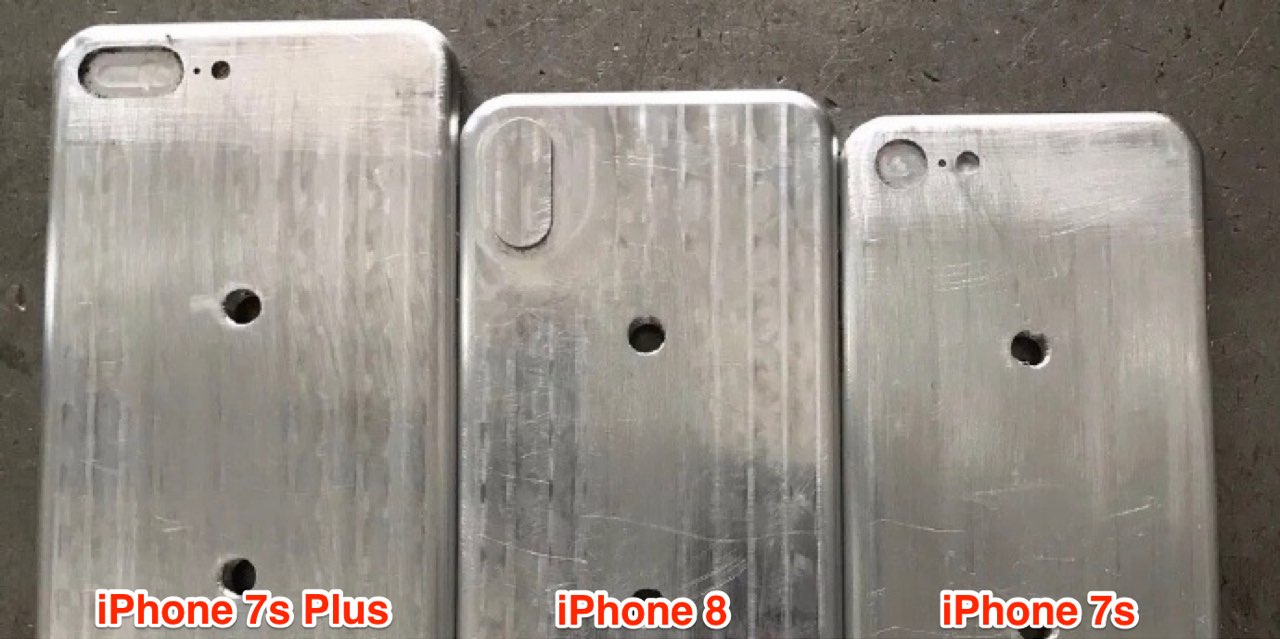
Some of them probably sport a rear Touch ID, just in case Apple's plan to integrate a next-generation fingerprint sensor into the display assembly falls apart. To give you a better idea what an iPhone with a rear Touch ID might look like, do check out the images of an iPhone 8 clone from China, some of which you can see above.

Apple is likely to unveil its 2017 iPhone lineup at a media event in September.

Aside from a new premium design and a full-front OLED display, iPhone 8 is widely expected to feature wireless charging, 3D facial scanning, a ten-nanometer A11 chip designed by Apple, augmented reality features and, of course, iOS 11 that Apple will preview at WWDC next month.

Check out this iPhone 8 clone with rear fingerprint sensor

The images of an iPhone 8 clone that hit the web yesterday give us a good indication what an iPhone 8 with a rear-mounted Touch ID sensor might look like. According to Benjamin Geskin, who tweeted out the rendered images, the device is based on an early iPhone 8 prototype.

The images were originally posted on Chinese social media platform Weibo. “All my sources said that this is totally wrong design,” Geskin cautioned, adding that iPhone 8 “is not going to look like that.”

The phone sports a slim bezels on the front face with no physical Home button.

On the back, we can clearly see a vertically stacked dual-lens camera and a Touch ID-like sensor, positioned below the Apple logo. The copycat device features an aluminum chassis.

iPhone 8, as you know, is said to feature a glass sandwich design in order to avoid any potential interference with its wireless charging components.

The placement of the fingerprint sensor on China's iPhone 8 clone actually makes sense to me: it's relatively easily reachable with one's index finger, as opposed to Galaxy S8's fingerprint sensor positioned next to the rear camera.

Some reports have suggested that one of the more than ten iPhone prototypes Apple has been testing has a rear Touch ID. Newer reports, however, have indicated that Apple has managed to integrate Touch ID into the display assembly after all.

Still, the company was smart enough to engineer an iPhone with a rear Touch ID as a fallback device, just in case.

To me, the biggest takeaway from looking at these renderings is that iPhones would look much better with some additional color options beyond the usual black, silver and gold choices.

Can you guess what the only app on Trump’s iPhone is?

Of course you can, it's Twitter.

Axios reporter Mike Allen wrote on Thursday that he learned from White House officials that the key to forcing a more disciplined President Trump is limiting his screen time. “In Trump's case, it's curtailing his time watching TV and banging out tweets on his iPhone,” he wrote.

Here's an excerpt from the report:

Trump himself has been pushing staff to give him more free time. But staff does everything it can to load up his schedule to keep him from getting worked up watching cable coverage, which often precipitates his tweets. It has worked well overseas so far.

During last year's campaign, Trump tweeted from an Android device.

After The New York Times described Trump's Galaxy S3 phone as an “old, unsecured” device posing a hacking risk because it had not received a security update since 2015, Trump switched to an iPhone this summer.

In terms of security and software updates, iPhone has a distinct advantage over Android.

iOS software updates are immediately available across all supported devices in the wild because carriers don't get to vet them.

iPhone is also a better pick than older Android devices in terms of security.

New York Magazine’s Executive Editor named Editor in Chief of Apple News

Apple has created a new Editor-in-Chief position for Apple News, naming Lauren Kern, Executive Editor at New York Magazine, to the position. It's unclear what exactly Kern's new role will entail, Politico said.

The move is being described as “sure to raise eyebrows” in media circles.

Kern is one of New York magazine’s “most high-ranking editors,” said Politico. Prior to joining New York Magazine, she was a deputy editor at The New York Times Magazine. The hiring suggests Apple intends to advance the Apple News service and the stock News app.

Apple executive Eddy Cue said in February that Apple wants to cut down on clickbait on Apple News. The company, said Cue, wants to “vet and make sure that the news providers in Apple News are legitimate.”

Following its 2015 debut which replaced Apple Newsstand, Apple News is currently available in the United States, the United Kingdom and Australia. iOS 10 brought out an Apple Music-like redesign for Apple News with bold headings, larger images and other visual tweaks.

Kern declined to comment and Apple has yet to confirm the hiring.

Alleged Apple vacation blackout could suggest iPhone keynote in September

Apple is reportedly canceling vacations for retail specialists between September 17 and November 4, according to a leaked memo sent to AppleCare Advisors and Leaders which was shared on Twitter this morning by prolific leakster Benjamin Geskin.

Based on the aforementioned blackout days, and assuming the pattern follows previous years, it's easy to imagine an iPhone keynote on either Wednesday, September 20 or September 13.

Conversely, pre-orders should go live on Friday, September 22, meaning iPhone 7s and iPhone 7s Plus (maybe even iPhone 8?) could go on sale on Friday, September 29.

Here's an excerpt from Apple's message:

The upcoming months are going to very exciting for all of us and for our customers. As you know, there are new product announcements and launches in September. In anticipation of the upcoming events and the corresponding heightened call volume expected, we will be increasing our staff across all of our programs over the summer.

In order to support our client during this very important time of year, we will be implementing Black Out Days in all AppleCare programs for Advisors and Leaders. The upcoming Black Out dates will be September 4 through November 4.

Apple notes that these dates are subject to change “as our support volume expectations fluctuate.” During blackout days, employees are restricted from requesting vacation.

“It is extremely important that everyone works their assigned scheduled days during this period—absences are unacceptable,” notes the firm.

https://twitter.com/VenyaGeskin1/status/867774248219267072

As with all leaks by Geskin, take this report with a pinch of salt until we're able to verify this piece of information with other sources. For instance, there are spelling mistakes in the memo.

Stanford study praises Apple Watch’s heart rate monitoring, calorie counting needs more work

A new medical study from Stanford University focusing on consumer fitness tracker reliability, published Wednesday in the Journal of Personalized Medicine, has crowned Apple Watch the king of heart rate monitoring while pointing out shortcomings in its calorie counting feature.

“People are basing life decisions on the data provided by these devices,” Euan Ashley, DPhil, FRCP, professor of cardiovascular medicine, of genetics and of biomedical data science at Stanford said in a statement.

The study included 29 male and 31 female volunteers who wore several fitness trackers like Basis Peak, Fitbit Surge, Microsoft Band, MIO Alpha 2, PulseOn, Samsung Gear S2 and Apple Watch. The study pitted the wearable gadgets against FDA-approved equipment.

The participants were asked to complete a total of 80 physical tests, including such activities as cycling, running and walking. They compared data against an FDA-approved 12-lead electrocardiograph for measuring heart rate and clinical-grade indirect calorimetry, which determines calories burned by measuring oxygen and carbon dioxide expelled when breathing.

Heart-rate monitoring via Apple Watch achieved the highest accuracy across measured modes of activity with an error rate of two percent, followed by Basis Peak and Fitbit Surge.

Samsung's Gear S2 had the highest heart rate error rate at 6.8 percent.

Researchers set an acceptable error rate at five percent, meaning Samsung's device fell just outside the study's acceptable buffer.

All fitness devices they tested fell short in calorie counting.

In terms of determining the amount of calories burned, Fitbit's Surge was the most accurate device with an error rate of 27.4 percent. PulseOn was the least accurate tracker in terms of calorie count with an astounding error rate of 92.6 percent. Apple Watch had an error rate near 40 percent while Microsoft Band came in at around 33 percent.

Low-impact activities like sitting caused the most inaccuracies with an average error rate of 52.4 percent compared against high-impact activities, such as walking and running.

This is due to the differences in how people exercise. “People are so variable,” Ashely said. “Some people walk smoothly and others waddle along, and that has an impact."

“The heart rate measurements performed far better than we expected, but the energy expenditure measures were way off the mark,” she added.

“The magnitude of just how bad they were surprised me.”

Each of the tested devices uses its own proprietary algorithm for calculating calorie burn, which could explain the wildly differing readings in terms of energy expenditure rates.

Facebook rolls out revamped Trending results page

Facebook announced yesterday a new look for Trending results page, which is the page you see when you click on a Trending topic to learn more about it.

“You’ve always been able to click on a topic to see related posts and stories, but we’ve redesigned the page to make it easier to discover other publications that are covering the story, as well as what your friends and public figures are saying about it,” said the company.

Tapping a Trending topic now pulls up a carousel with stories from other publications that you can swipe through to see what other news outlets are saying about each topic. The stories that appear in this section are some of the most popular stories about that topic on Facebook.

If you haven't used Trending before, that's because the feature can be quite difficult to find in Facebook's mainland mobile app. To address that issue, Facebook will soon kick off a test in News Feed that will show people the top three Trending stories, which they can tap to reveal the full list of Trending topics and explore what others are discussing on Facebook.

While most people will not see Trending in their News Feed, those who do can remove it easily via a popup menu to prevent Trending items from being shown to them in the future.

You’ll be able to see the new Trending results page on iPhone in the US. They plan to make it available on Android and desktop soon.