iFixit extends its discounted DIY $30 iPhone battery replacement service through 2019

Apple's iPhone battery replacements are no longer available at a deep discount so repair site iFixit has decided to extend its own DIY iPhone battery discount through 2019.

iFixit wrote:

When Apple first announced their $29 battery replacement program in December 2017, we lowered the price of our DIY iPhone battery kits to match. Last month, Apple’s discounted battery replacement program ended, and they raised the price of their battery service from $29 to $49 (or $69, depending on your model).

In the wake of last year's iPhone throttling drama, the repair site lowered the price on all of its DIY iPhone battery fix kits to $29 or less. According to Barclay’s, 519 million iPhones were eligible for Apple's discounted program but the company replaced only eleven million batteries.

That means there are still hundreds of millions of affected iPhone owners who didn’t get a battery replacement—or didn’t know they needed one. So in a fit of righteous solidarity, we’re guaranteeing our iPhone battery prices will remain at $29.99 for at least the rest of the year.

The iFixit kits include everything you need to open up and swap your own battery. And unlike Apple's own program, iFixit's battery kits are available for older iPhones like iPhone 4S, iPhone 5, iPhone 5s and iPhone 5c.

iFixit notes that the eleven million batteries Apple replaced is ten times the company's average repair rate of about one to two million iPhone battery replacements a year.

A year ago, Apple was charging $79 for iPhone batteries.

Apple currently charges out of warranty battery replacements at $69 a pop for iPhone X, iPhone XS, iPhone XS Max and iPhone XR. Older models like iPhone SE, iPhone 6, iPhone 6 Plus, iPhone 6s, iPhone 6s Plus, iPhone 7, iPhone 7 Plus, iPhone 8, iPhone 8 Plus "and all other eligible models" are subject to a $49 battery replacement fee.

Of course, if you have AppleCare+ protection, battery replacements are free.

Cook: iPhone sales slowed due to higher prices, death of subsidies & less frequent upgrades

Tim Cook sitting at a table outside the Apple Park headquarters

Apple's boss Tim Cook has admitted in yesterday's conference call following the latest quarterly earnings report that—aside from China—other factors such as higher prices, death of subsidies in many countries and customers holding on to their handset a bit longer than usual have all contributed to a decline in iPhone upgrades.

Jason Snell has transcribed Apple’s earnings call on Six Colors, here's what Cook said when an analyst pressed him on Apple's pricing strategy (emphasis mine):

Steve Milunovich, Wolfe Research: Some have the perception that you priced the new products, the new iPhones, too high. What have you learned about price elasticity and do you feel that perhaps you pushed the envelope a little bit too far and might have to bring that down in the future?

Tim Cook: Steve, it’s Tim. If you look at what we did this past year, we priced iPhone XS in the US the same as we’d priced iPhone X a year ago. iPhone XS Max, which was new, was a hundred dollars more than the XS, and then we priced the XR right in the middle of where the entry iPhone 8 and entry iPhone 8 Plus had been priced. So it’s actually a pretty small difference in the United States compared to last year.

He continued:

However, the foreign exchange issue that Luca spoke of in the call amplified that difference in international markets, in particular the emerging markets, which tended to move much more significantly versus the dollar.

And so what we have done in January in some locations and some products is essentially absorb part or all of the foreign currency move as compared to last year and therefore get close or perhaps right on the local price from a year ago.

So yes, I do think the price is a factor.

I remember Apple executives arguing in the past that iPhones weren't just for the rich people. But I digress, here's what Cook had to say about the death of the smartphone subsidy.

Secondly, in some markets, as I had talked about in my prepared remarks, the subsidy is probably the bigger of the issues in the developed markets.

I had mentioned Japan, but also even in this country, even though the subsidy has gone away for a period of time, if you’re a customer that your last purchase was a 6S or a 6 or in some cases even a 7, you may have paid 199 dollars for it. And now, in the unbundled world it’s obviously much more than that.

Cook says they have a number of actions to address the decline in iPhone upgrade rates, including the aggressive trade-in offers and and installment payments.

The Apple story is shifting from iPhone units to ecosystems and services.

The CEO concluded:

So where it goes in the future, I don't know. But I am convinced that making a great product that is high quality, that is the best thing for the customer. We work for the user and so that's the way that we look at it.

In the press release announcing quarterly earnings, Cook praised other aspects of Apple's business that have experienced healthy growth.

While it was disappointing to miss our revenue guidance, we manage Apple for the long term, and this quarter’s results demonstrate that the underlying strength of our business runs deep and wide.

Our active installed base of devices reached an all-time high of 1.4 billion in the first quarter, growing in each of our geographic segments. That’s a great testament to the satisfaction and loyalty of our customers, and it’s driving our Services business to new records thanks to our large and fast-growing ecosystem.

Apple no longer reports units sales for iPhone and other products, robbing investors of the most important metric as the company transitions its story from one heavily dependent on iPhone to a combined products + services business.

During the holiday quarter, the Cupertino company pulled in $84.3 billion in revenue, a decline of 5% from the year-ago quarter. Strategy Analytics estimates that 65.9 million iPhones were shipped during the quarter, or 11.4 million fewer handsets versus the year-ago quarter.

BLightAlert leverages your iPhone’s display brightness to get your attention for notifications

iOS’ notification system tends to be subtle enough that it can be easy to forget or miss an incoming notification. Fortunately, a free jailbreak tweak called BLightAlert by iOS developer Julio Verne can help mitigate this problem.

BLightAlert leverages your handset’s display backlight to grab your attention for incoming notifications. Once installed, the display brightness changes rapidly from low to high for a couple of seconds whenever an incoming notification rolls in, like so:

BigShotJb lets you capture taller screenshots more easily

I snap so many screenshots on my iOS devices each day that even the world’s most renowned mathematicians would need a calculator to keep count, but the situation is intensified when I capture tall vertical interfaces; doing so often requires snapping several screenshots that will need to be stitched together in photo-editing software afterward.

If you’ve ever been in a similar predicament, then you know what a pain this can be and you’ll be ecstatic to know there’s another way. A free jailbreak tweak dubbed BigShotJb (iOS 11) by iOS developers tapthaker and Julio Verne lets you capture tall vertical screenshots just like the one in the example above with minimal effort.

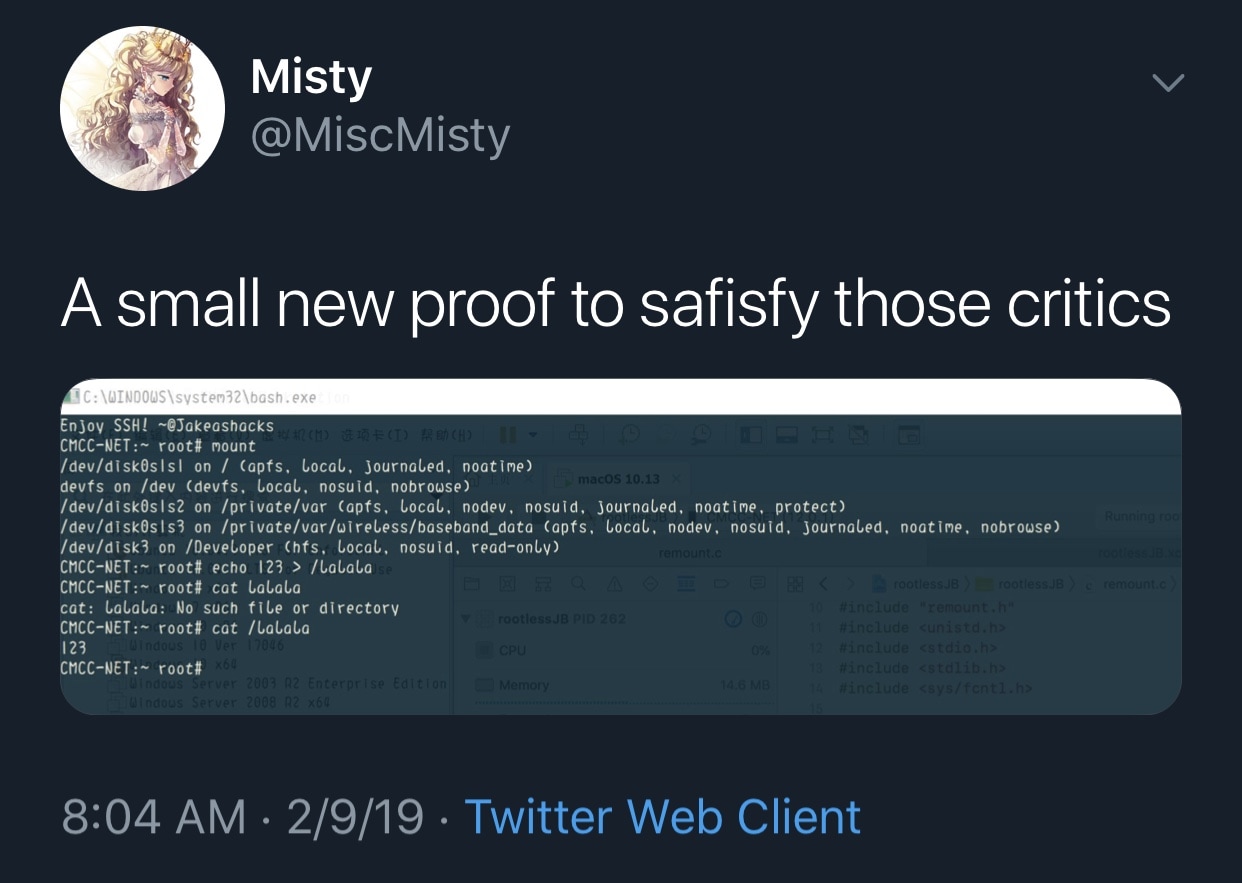
Security researcher Brandon Azad publishes voucher_swap exploit for pre-iOS 12.1.2 devices

Matrix code hacked iPhone.

Not long after tihmstar published his iOS 11.4-11.4.1-centric tfp0 exploit for headphone jack-enabled handsets, security researcher Brandon Azad followed up by releasing an exploit of his own intended for devices running iOS 12.1.2 and earlier.

Azad shared the news via Twitter Tuesday afternoon, including a link to documentation encompassing the exploit:

In change of heart, tihmstar releases tfp0 exploit for certain iOS 11.4-11.4.1 devices

Just over two weeks ago, it became known that hacking guru tihmstar was tinkering with a tfp0 exploit for iOS 11.4-11.4.1 devices of the A10 and earlier variety. But not long after finishing it, he opted not to release it, citing that ‘something cool’ would be coming instead.

Curiously, tihmstar appears to have undergone a change of heart on Tuesday after releasing his exploit to the public, a move that could reinforce existing iOS 11-centric jailbreak tools such as Electra and unc0ver:

Apple reports Q1 2019 revenue of $84.3B

Apple on Tuesday disclosed its [fiscal] Q1 2019 earnings report, offering a look at its performance over the past 3 months. During the holiday period, the company says it pulled in $84.3B in revenue, a decline of 5% from the year-ago quarter.

Pwn20wnd revises the unc0ver v2.2.0 pre-release with rewritten Cydia installation & other changes

Not long after advising the jailbreak community about what to do regarding the FaceTime-centric bug and the impending software update from Apple to fix it, hacker and unc0ver lead developer Pwn20wnd revised the unc0ver v2.2.0 pre-release this afternoon with some notable changes.

Citing the hacker’s official GitHub page, Tuesday’s update marks the fourteenth revision to the unc0ver v2.2.0 pre-release since its initial conception just over a week ago. The new revision appears to incorporate the following changes: